


Types of Solar Geysers (Solar Water Heating Systems)
Understanding the different types of solar geysers is essential before installation: the right choice impacts performance, compliance, energy savings, lifespan, and maintenance costs.
South African building regulations and industry standards (referenced below) influence design, installation, and certification. We explain each type technically and practically
Solar Geysers Defined
A solar geyser is a solar-assisted hot water system that uses solar energy to heat water, reducing or eliminating reliance on electrical resistance heating. A compliant system must meet SANS requirements for:
-
Performance
-
Safety
-
Structural installation
-
Energy efficiency
Solar geyser systems are governed by multi-standard requirements including SANS 10106 (installation), SANS 1307 (performance and construction), and related plumbing and energy efficiency standards. You need a qualified solar geyser installer who has experience, like Juspropa.
Classification of Solar Geyser Systems
Solar water heaters are best understood by how they circulate water and configure collector and storage.
1. Passive Solar Geysers
Passive systems circulate water by natural convection—hot water rises while cold water descends.
a. Thermosiphon Systems
How they work:
Solar collectors are below the storage tank, usually roof-mounted. Heated water naturally rises into the tank without pumping.
Benefits
-
No electrical auxiliary pump required
-
Fewer moving parts (lower maintenance)
-
Highly reliable in temperate climates
Considerations
-
Storage tank must be above collectors
-
Roof structural support must be verified
Compliance notes:
Installation must comply with SANS 10106 for plumbing and safety. SANS 10400-XA requires non-electric heating to provide at least 50 % of annual hot water energy. Book Juspropa Installers Now
2. Active Solar Geysers
Active systems use a pump and controller to move water between the collector and storage.
a. Pump-Circulated Systems
How they work:
A small, solar-specific pump moves water or heat transfer fluid between the collector and insulated storage vessel.
Benefits
-
Greater flexibility in tank placement (e.g., in roof space or basement)
-
Optimised performance when solar exposure is variable
-
Better integration with large or complex roofs
Considerations
-
Requires an electrical source for the pump
-
Slightly higher maintenance than passive
SANS relevance:
All components (pump, controller, valves) must meet acceptable standards and be installed by a technician aware of SANS 10106 and associated requirements. We use the Geyserwise 12V or 220V Circulation pump. Get a Geyserwise system now
Major Solar Geyser Types by Construction and Use
A. Close-Coupled Solar Geyser
Configuration:
The collector and storage tank are mounted together on the roof.
Advantages
-
Compact design
-
Lower piping heat loss
-
Simpler installation
Best used for
-
Roof-mounted residential installations
-
Areas with strong sunlight and minimal freezing risk
B. Split Solar Geyser System
Configuration:
Collector panels are roof-mounted while the storage tank is placed separately (typically in roof space).
Advantages
-
Reduced roof load
-
Better insulation and heat retention
-
Improved aesthetics
Best used for
-
Multi-storey homes
-
Properties with space constraints
This configuration requires precise fluid routing and control systems to ensure performance.
C. Retrofitted Solar Geyser Conversions
What this is:
An existing electrical geyser is adapted using solar collectors to pre-heat water and reduce electrical consumption.
Benefits
-
Lower upfront cost
-
Quick conversion for existing homes
Critical compliance point:
Retrofit systems must still meet SANS 10106 and energy compliance criteria under SANS 10400-XA; poorly designed retrofit systems can fail to reduce electrical heating sufficiently to satisfy the minimum 50 % renewable heating requirement. Book Juspropa Qualified Technicians Now.
Solar Collector Types (Technical Differences)
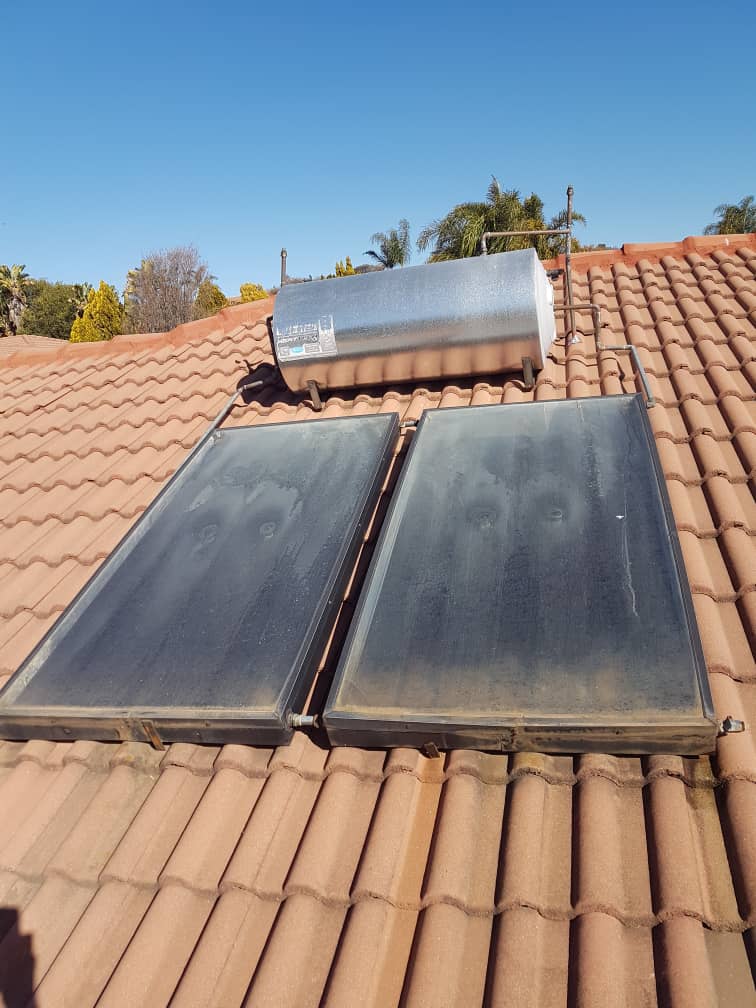
1. Flat Plate Collectors
-
Good general performance
-
Simple and robust
-
Suited for residential climates
Performance note:
Effective at capturing diffuse and direct solar radiation.
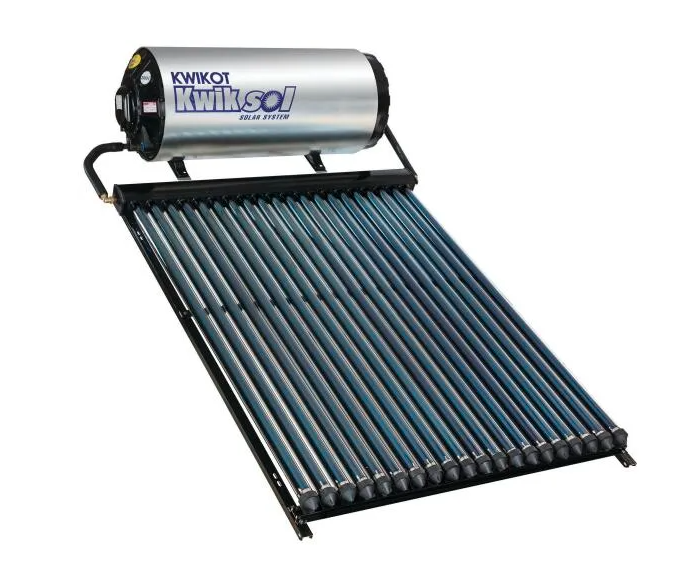
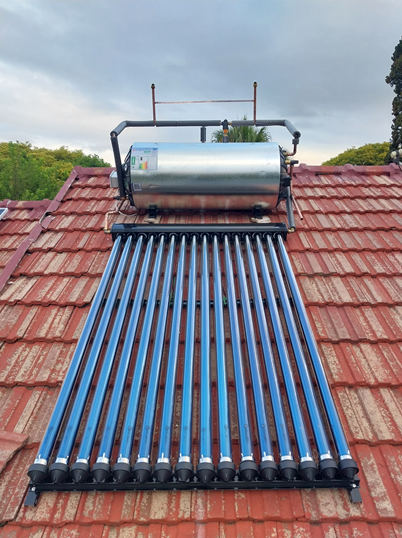
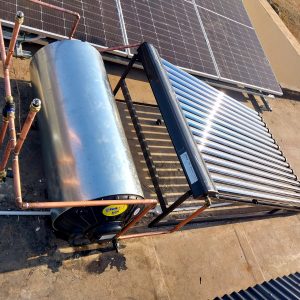
2. Evacuated Tube Collectors
-
Higher thermal efficiency, especially in cooler conditions
-
Tubes reduce heat loss
Use cases
-
Northern climates or high wind exposure
-
Systems where continuous heat capture is prioritised
South African Regulatory Context for Solar Geysers
Solar geyser installations in South Africa must be compliant not only with individual component standards but with building regulations that govern energy usage and installation safety.
SANS 10400-XA – Energy Usage in Buildings
-
Requires a minimum of 50 % of hot water energy from non-electrical sources such as solar or heat pumps, determined according to SANS 10252-1 guidelines.
SANS 10106 – Solar Water Heater Installation
-
Covers installation, maintenance, repair, and replacement practices.
-
Ensures systems are installed safely, with proper support, insulation, safety valves, and compliance documentation.
SANS 1307 – Domestic Solar Water Heating Systems
-
Governs performance, durability, and testing of integrated solar geyser systems.
-
A complete system must be tested and certified, not just isolated components.
Related Standards That Matter
-
SANS 10254 — Water heater installation practices (safety and code)
-
SANS 204 — Energy efficiency (insulation standards)
-
SANS 6210 / SANS 6211 — Thermal performance and mechanical qualification tests
-
SANS 151 / SANS 60335 — Safety and storage requirements for water heaters
Expert Guidance: Best Installation Practices
Solar geyser performance depends on several variables:
Ideal Orientation and Placement
-
North-facing collectors maximise solar gain.
-
Roof panels should be free from shading by trees or neighboring structures
Roof Suitability
-
Structural assessment for weight and wind loads is critical.
-
Roof fixing must not compromise waterproofing or roofing integrity.
System Size Matching
-
Typical sizing: roughly 1 m² of collector per household member as a rule of thumb for solar system sizing
Performance Graph
Below is a simplified conceptual graph description to support content quality and understanding (replace with real image later):
Solar Geyser Efficiency vs. Roof Orientation
Key Insight: North-facing systems consistently produce the highest thermal gain, outperforming East/West by 15–30%.
Why This Matters
Choosing the right type of solar geyser system is not just a matter of picking components; it involves:
-
Thermal performance matching household consumption
-
Compliance with SANS performance and installation standards
-
Energy regulation and national building code alignment
-
Installer qualification and certification issuance
Improper installation or incorrect system selection can lead to poor performance, compliance failures, insurance disputes, and higher lifetime costs.
Types of Solar Geysers Explained in Depth (South Africa)
Solar geysers are not a single technology. They are a family of systems, each designed for specific operating conditions, pressure requirements, budgets, and compliance scenarios. Understanding these distinctions is critical for performance, safety, and certification.
Below is a complete technical breakdown of the most relevant solar geyser types used in South Africa.
1. Flat Plate Solar Geysers
How Flat Plate Solar Geysers Work
Flat plate collectors consist of:
-
A dark absorber plate
-
Copper or aluminium pipes bonded to the plate
-
An insulated casing with a glass cover
Solar radiation heats the absorber plate, which transfers heat to the water (or heat-transfer fluid) flowing through the pipes.
Advantages
-
Robust and proven technology
-
Performs well in Gauteng’s climate
-
Lower cost than evacuated tube systems
-
Long lifespan with minimal maintenance
Disadvantages
-
Slightly lower efficiency in very cold or windy conditions
-
Heavier than evacuated tube collectors
Best Use Cases
-
Residential homes
-
Areas with good year-round sunlight
-
Close-coupled and split systems
2. Evacuated Tube Solar Geysers
How Evacuated Tube Systems Work
Evacuated tube collectors consist of multiple glass tubes with a vacuum between layers. This vacuum dramatically reduces heat loss. Each tube transfers heat to a central manifold, which heats the water or transfer fluid.
Advantages
-
Higher thermal efficiency
-
Excellent cold-weather and low-light performance
-
Reduced heat loss
Disadvantages
-
Higher upfront cost
-
Tubes can be more fragile
-
Overheating risk if not properly controlled
Best Use Cases
-
High-demand households
-
Cooler regions or shaded environments
-
Premium split solar geyser systems
3. Retrofit Solar Geyser Systems
How Retrofit Systems Work
A retrofit system uses solar collectors to pre-heat water before it enters an existing electric geyser. The electric element only activates if the solar-heated water is below the required temperature.
Advantages
-
Lower initial cost
-
Makes use of existing geyser infrastructure
-
Faster installation
Disadvantages
-
Lower solar contribution than full solar systems
-
Must be carefully designed to meet SANS 10400-XA energy requirements
Compliance Note
Retrofit systems must still achieve the minimum renewable contribution required by SANS 10400-XA. Poorly designed retrofits often fail compliance inspections.
4. Thermosiphon Solar Geysers (Passive Systems)
How Thermosiphon Systems Work
Thermosiphon systems rely on natural convection:
-
Cold water flows into the collector
-
Heated water rises naturally into the storage tank
-
No pumps or controllers are required
Advantages
-
No electrical components
-
Extremely reliable
-
Low maintenance
Disadvantages
-
The tank must be higher than the collectors
-
The roof must support the tank’s weight
Regulatory Consideration
Structural load assessment is essential to remain compliant with SANS 10106 and building safety standards.
5. Direct Thermosiphon Solar Geysers
How Direct Thermosiphon Systems Work
In direct systems, potable water flows directly through the collectors and into the storage tank.
Advantages
-
Simple design
-
High efficiency
-
Lower cost
Disadvantages
-
Susceptible to freezing
-
Scale build-up in hard-water areas
Best Use Cases
-
Mild climates
-
Areas with low frost risk
6. Indirect Thermosiphon Solar Geysers
How Indirect Thermosiphon Systems Work
Indirect systems circulate a heat-transfer fluid (usually glycol) through the collectors. Heat is transferred to potable water via a heat exchanger.
Advantages
-
Freeze protection
-
Reduced scaling
-
Improved system longevity
Disadvantages
-
Higher installation cost
-
Requires periodic fluid replacement
Best Use Cases
-
Areas with frost risk
-
High-altitude regions
-
Premium residential systems
7. Close-Coupled Solar Geysers
How Close-Coupled Systems Work
The collector and storage tank are mounted together on the roof, using thermosiphon circulation.
Advantages
-
Compact design
-
Minimal heat loss
-
Cost-effective
Disadvantages
-
Heavy roof loading
-
Visual impact
-
Limited placement flexibility
Compliance Reminder
Roof penetration and load-bearing must meet SANS 10106 and general building safety standards.
8. Low Pressure Solar Geysers
How Low Pressure Systems Work
Low pressure systems are not connected directly to municipal mains pressure. Water is gravity-fed from a header tank.
Advantages
-
Lower system stress
-
Reduced risk of leaks
-
Suitable for rural or off-grid applications
Disadvantages
-
Cannot supply modern high-pressure plumbing fixtures
-
Limited household compatibility
Important Note
Low-pressure systems are not suitable for most urban homes unless specifically designed with appropriate plumbing modifications.
Comparative Summary Table
| System Type | Efficiency | Cost | Pressure | Best Application |
|---|---|---|---|---|
| Flat Plate | High | Medium | High | General residential |
| Evacuated Tube | Very High | High | High | Premium systems |
| Retrofit | Medium | Low | High | Budget upgrades |
| Thermosiphon | High | Medium | High | Roof-mounted |
| Direct Thermosiphon | High | Low | High | Mild climates |
| Indirect Thermosiphon | Very High | High | High | Cold regions |
| Close-Coupled | High | Low | High | Simple installs |
| Low Pressure | Medium | Low | Low | Rural/off-grid |
Expert Insight
There is no universally “best” solar geyser—only a best-matched system.
Solar Geyser Comparison Charts
Solar Geyser Types – At-a-Glance Comparison
Overall System Comparison
| Solar Geyser Type | Efficiency | Installation Cost | Maintenance | Pressure Compatibility | Best Use Case |
|---|---|---|---|---|---|
| Flat Plate | High | Medium | Low | High pressure | Most residential homes |
| Evacuated Tube | Very High | High | Medium | High pressure | High-demand / premium systems |
| Retrofit | Medium | Low | Low | High pressure | Budget upgrades |
| Thermosiphon | High | Medium | Very Low | High pressure | Reliable roof-mounted systems |
| Direct Thermosiphon | High | Low | Low | High pressure | Mild climates |
| Indirect Thermosiphon | Very High | High | Medium | High pressure | Frost-risk areas |
| Close Coupled | High | Low | Very Low | High pressure | Simple residential installs |
| Low Pressure | Medium | Low | Very Low | Low pressure only | Rural / off-grid properties |
Efficiency Comparison (Technical Perspective)
Thermal Performance Ranking
-
Evacuated Tube Systems – Highest efficiency due to vacuum insulation
-
Indirect Thermosiphon Systems – Excellent heat retention and frost protection
-
Flat Plate Systems – Consistent and reliable in Gauteng conditions
-
Thermosiphon / Close-Coupled Systems – Strong performance with minimal complexity
-
Retrofit Systems – Moderate efficiency (solar-assisted)
-
Low Pressure Systems – Lower output due to system limitations
Expert Insight:
Efficiency depends more on correct system matching and installation than advertised performance figures.
Cost Comparison
Upfront Installation Cost (Lowest → Highest)
-
Low Pressure
-
Retrofit
-
Close Coupled
-
Direct Thermosiphon
-
Flat Plate
-
Thermosiphon (split)
-
Indirect Thermosiphon
-
Evacuated Tube
Lower upfront cost does not always mean lower lifecycle cost. Systems with poor efficiency or compliance often cost more over time.
Maintenance Comparison
Maintenance Requirements
| System Type | Maintenance Frequency | Key Maintenance Needs |
|---|---|---|
| Flat Plate | Low | Valve and pressure checks |
| Evacuated Tube | Medium | Tube inspection, overheating control |
| Retrofit | Low | Periodic compliance checks |
| Thermosiphon | Very Low | Minimal servicing |
| Direct Thermosiphon | Low | Scaling checks |
| Indirect Thermosiphon | Medium | Glycol replacement |
| Close Coupled | Very Low | Basic inspection |
| Low Pressure | Very Low | Gravity feed monitoring |
Climate and Area Suitability (South Africa)
Best Systems by Installation Conditions
Gauteng (Johannesburg, Sandton, Midrand, Centurion, Pretoria)
-
Flat Plate
-
Split Systems
-
Close Coupled
Frost-Prone or High-Altitude Areas
-
Indirect Thermosiphon
-
Evacuated Tube
Rural / Off-Grid Properties
-
Low Pressure
-
Direct Thermosiphon
Compliance & Standards Alignment
All systems must be selected and installed in line with:
-
SANS 10106 – Installation, safety, maintenance
-
SANS 1307 – Performance and system certification
-
SANS 10400-XA – Minimum non-electric hot water contribution
Incorrect system selection is one of the most common reasons for failed COCs.
Reviews
There are no reviews yet.